Vermilion Waterworks District No. 1 reports drinking-water byproduct above limit
The district says its four-quarter average reached 83 parts per billion at one testing point, above the 80-part-per-billion TTHM limit. The notice calls the violation non-emergency.
Developing
Published
Event date: 2026-10-03 (day)
Vermilion Parish Waterworks District No. 1 says its drinking water exceeded the limit for total trihalomethanes, or TTHMs, at one monitoring point. The district’s public notice, published October 3, puts the locational running annual average calculated for the third quarter of 2026 at 83 parts per billion at its Bernell-at-Highway-91 testing point. The limit is 80 parts per billion.
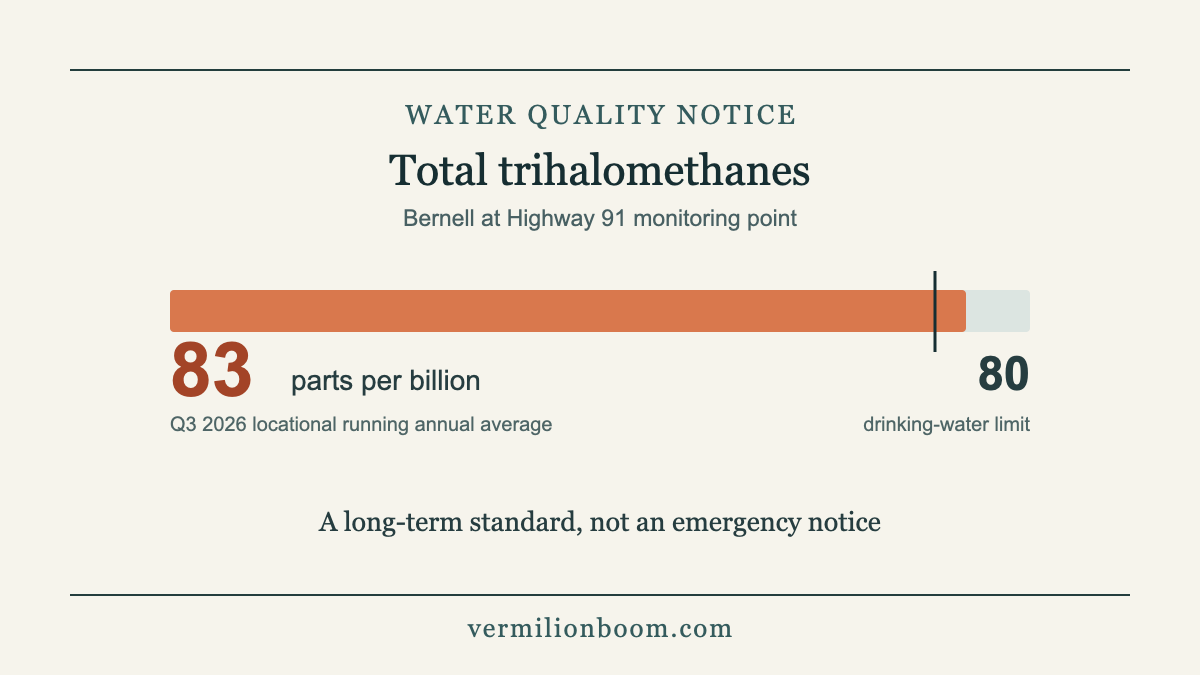
Vermilion Boom graphic using the district’s October 3 public notice. The measure is a four-quarter average at one monitoring point, not a test of every household tap.
The reported average is three parts per billion above the limit. A locational running annual average combines quarterly samples at a particular monitoring point; it does not describe a single day or every household tap. The notice is for people supplied by District No. 1, not every Vermilion Parish water customer. People unsure of their provider can check their water bill or call the district at 337-898-8345, the number printed in the notice.
TTHMs form when disinfectants used in water treatment react with material naturally present in water, the district’s October 3 notice explains. It says people who drink water with TTHMs above the limit over many years may face problems with their liver, kidneys or nervous system, or a higher cancer risk. The district calls this violation not an emergency and says it does not expect serious adverse effects from short-term exposure.
The TTHM notice does not instruct customers to boil water. Louisiana’s health department describes boil-water advisories as a separate response to possible biological contamination. That distinction does not replace any separate water advisory that may apply to a customer’s address.
The October 3 notice does not describe a corrective action or give an estimated resolution date. Customers can call the district for the latest test results, its response plan and any updated instructions. The notice also asks customers to pass the information to other people who drink district water but might not receive the notice directly, including people in apartments, schools, nursing homes and businesses.
Was this useful?
Help us keep useful reporting easy to find.